
Welcome to the Phocaean city ! As the capital of Provence, visiting Marseille is an experience that leaves no one indifferent. The city is full of iconic places to visit, between land and sea. Marseille is the oldest city in France, and its thousand-year-old heritage is matched only by the wild splendor of its natural landscapes.
Discover in this Marseille tourism guide the best places in the Phocaean city, to see whether you have 1, 2, 3 days or a whole week ahead of you.
Marseille tourism: the places you absolutely must visit
If you're wondering what to visit in Marseille, these essentials are a must for understanding the soul of the Phocaean city. From the Vieux-Port, the true beating heart of the city, to the basilica of Notre-Dame de la Garde, by way of the Mucem and the narrow streets of Le Panier, each site tells a facet of its thousand-year history.
Here are the 5 must-see places in Marseille !
1. The Vieux-Port
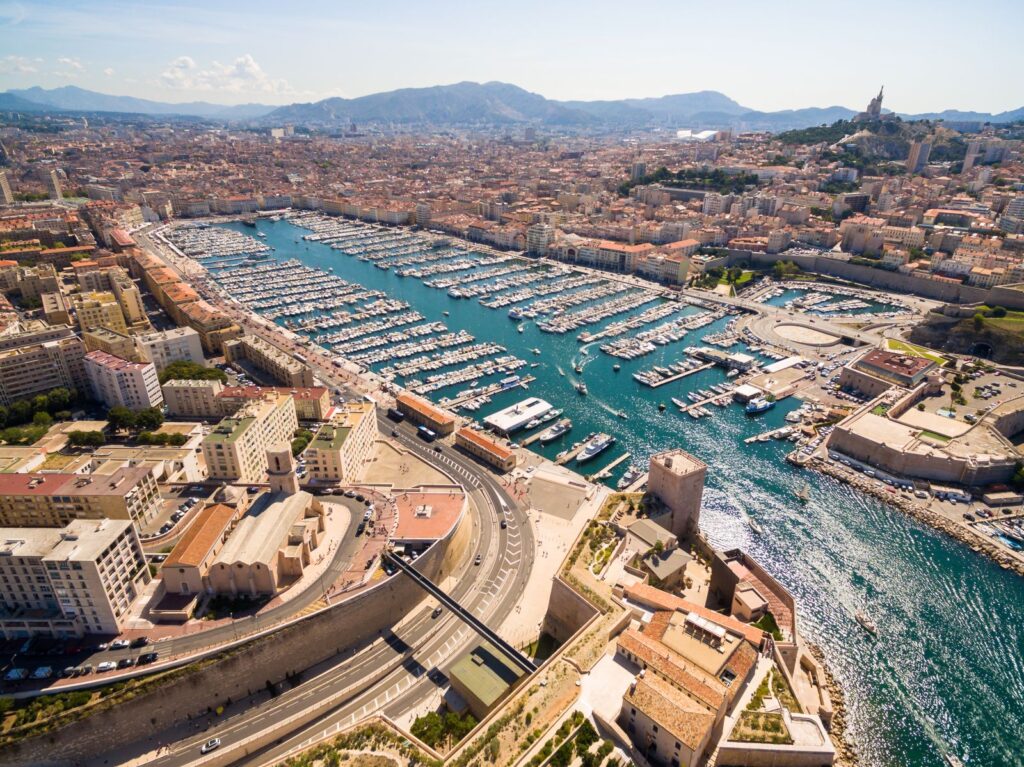
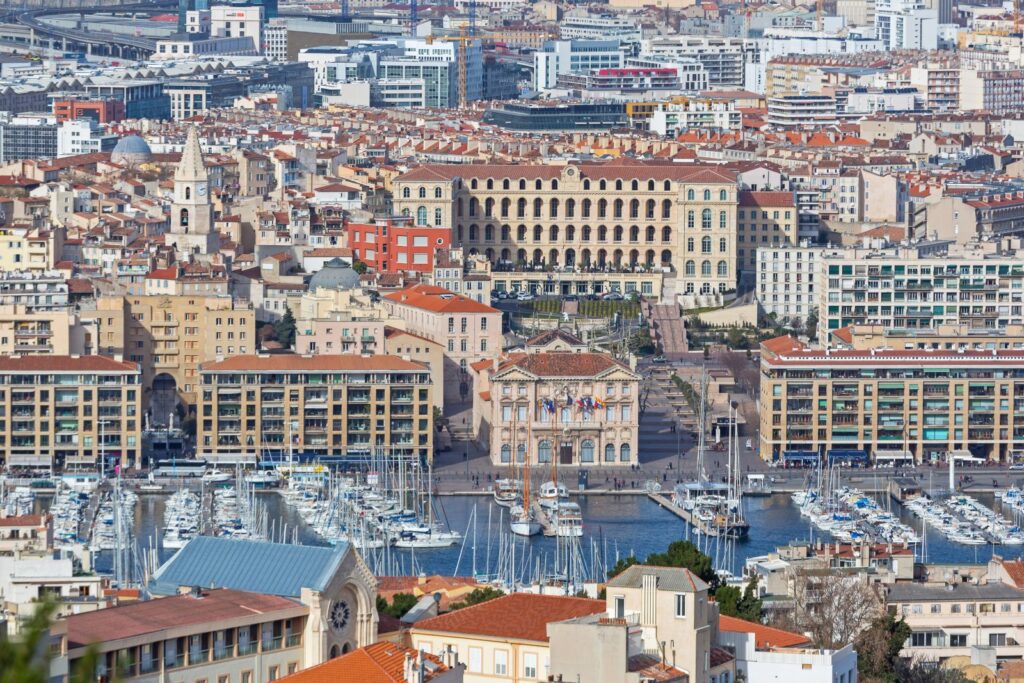
It's impossible to visit Marseille without stopping at the Vieux-Port! The Vieux-Port is one of the places to visit in Marseille first. You'll no doubt end up there by chance, as the Vieux-Port has been the nerve center of the city since antiquity. Many restaurants and bars line the shores of the Vieux-Port, leaving you a wide choice of places for breakfast, lunch, dinner, or simply a drink or an ice cream.
In particular, you can cross between the two banks of the Vieux-Port by boat. This is also the departure point of the little tourist train of Marseille, which takes you around the four corners of the city. In the morning, there is the iconic fish market. Otherwise, the Vieux-Port is generally always lively, especially under theombrière of the Vieux-Port. You can stop to admire Marseille's City Hall, an impressive architectural building dating from the 17th century.
The Vieux-Port can be reached by metro line 1 and by bus, served by line 49, line 60 as well as lines 55, 81, 82 and 83. You can also get there on foot, walking down the Canebière.
2. Notre-Dame de la Garde
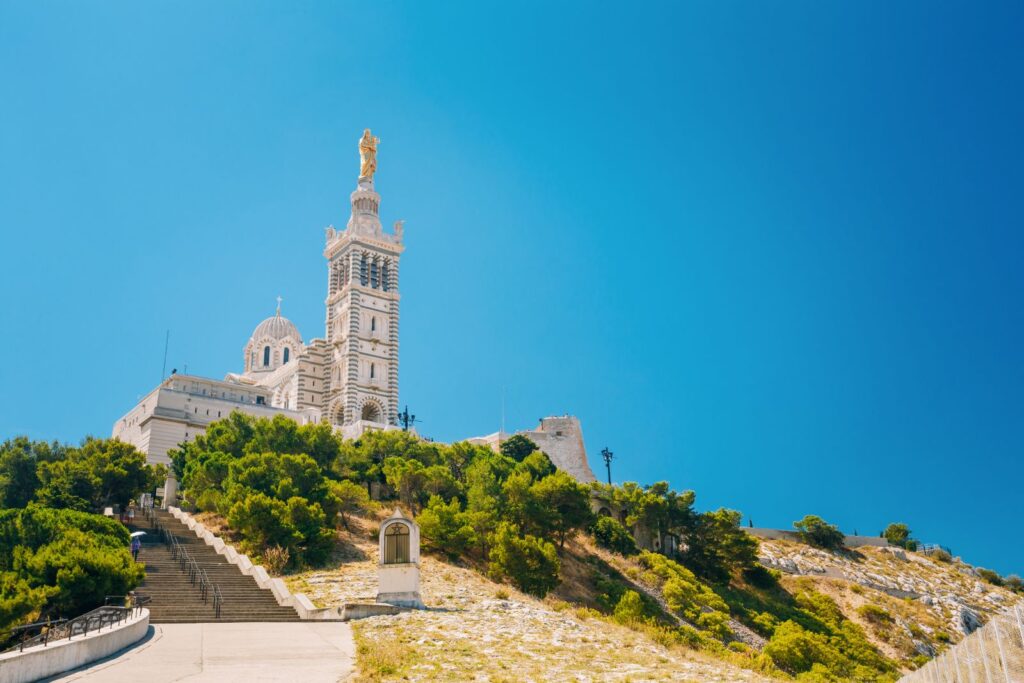
Nicknamed the “Good Mother”, this 19th-century Romano-Byzantine basilica sits at an altitude of 149 meters. It's the one you can see from afar, perched on its hill, or at least its 11-meter-high statue of the Virgin. Climbing up to Notre-Dame de la Garde is part of local life. It is a true symbol of protection for Marseille and all its people. The forecourt of the Good Mother offers a 360° panoramic view that is simply exceptional, over the Vieux-Port, the Frioul islands and the Calanques. It is also impressive for its architecture and its interior, rich in mosaics and marine ex-votos.
The basilica of Notre-Dame de la Garde is open every day from 7 am to 6 pm (free admission). There is a restaurant (open from 8:15 am to 4:30 pm) and a souvenir shop (open from 9 am to 5 pm).
You can get there on foot (about a 45-minute climb from the Vieux-Port), by car (free parking, but limited spaces), or by bus (line 60 from the Vieux-Port). Marseille's little tourist train also makes a stop at the Good Mother.
Notre article détaillé : Visiter Notre-Dame de la Garde à Marseille : infos pratiques, accès, vue, restaurants et balade
3. The Mucem
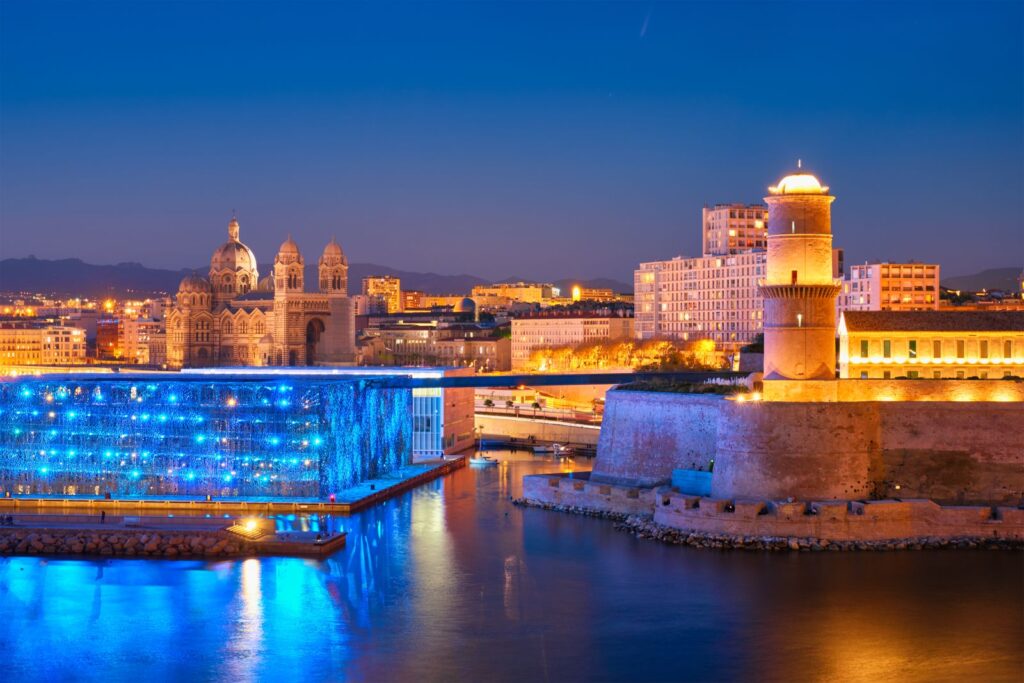
The Mucem is the Museum of the Civilizations of Europe and the Mediterranean, in other words the first major national museum devoted to Mediterranean cultures. Inaugurated in 2013, when Marseille was European Capital of Culture, it has become the new face of the city. Its architecture is among the most daring, designed by Rudy Ricciotti. The main building, the J4, is wrapped in a lattice of black concrete that lets in light and sea spray. Simply take the suspended footbridge, a 115-meter-long span stretched over the void, to reach Fort Saint-Jean and its botanical gardens overlooking the Mediterranean.
Inside the Mucem, you'll find permanent and temporary exhibitions that are truly unique in their approach. The exhibitions don't just display objects: they tell stories, tackling major themes that link past and present. The museum regularly invites contemporary artists (visual artists, videographers, photographers) to cast a fresh eye on the historical collections. Click here to discover the Mucem's exhibition program.
Admission is free for everyone on the first Sunday of the month. Single ticket : A single ticket (11 € full price) gives access to all the exhibitions at the J4 and Fort Saint-Jean. Access to the outdoor areas and the footbridge is free.
Open every day except Tuesday, generally from 10 am to 7 pm (varies by season).
Located at the entrance to the Vieux-Port, the Mucem can be reached on foot or via buses 82, 82s, 60 or the Vieux-Port metro.
4. The Cathédrale de la Major
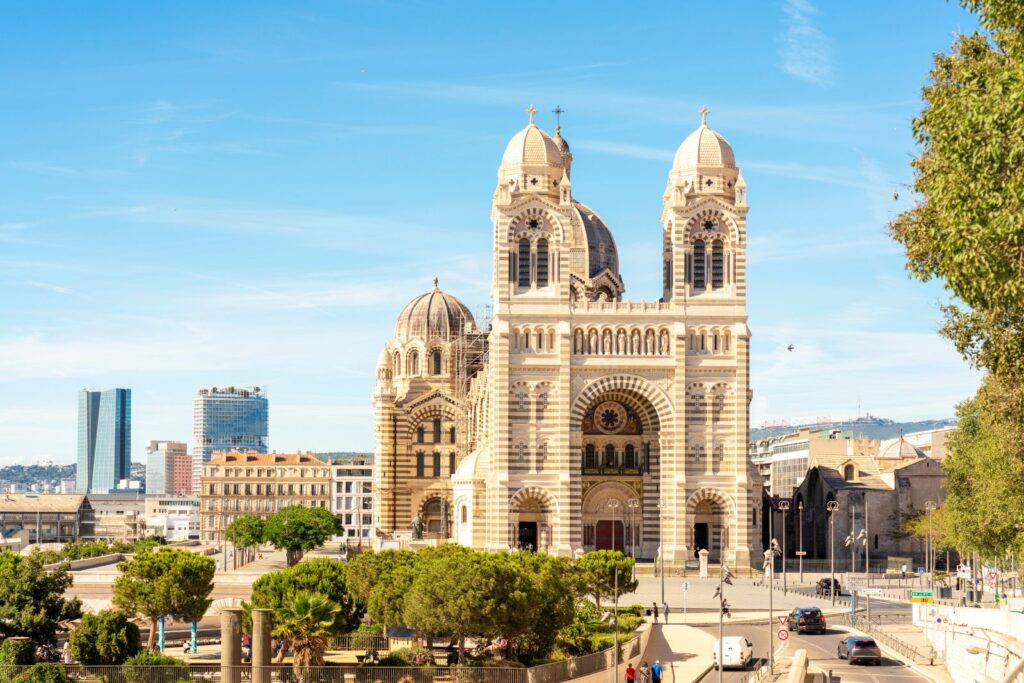
The Cathédrale de la Major is a 19th-century neo-Byzantine masterpiece, facing the sea, behind the Le Panier district and opposite the Mucem. It is also one of the must-see landmarks in Marseille !
It is a cathedral unlike any other in France, with a 142-meter nave, a dome 18 meters in diameter rising 70 meters high, with a capacity of 3,000 people during religious services! It is built of alternating green and white marble, with sumptuous mosaic and porphyry decorations. Inside, the floor is covered with Venetian mosaic that “lives” under the changing light of the domes, guiding visitors toward the cathedral's high altar. Recently restored, it is all the more majestic and well worth the detour. Its forecourt overlooks the port of Marseille-Fos, with a sweeping view over the Mucem, the Cosquer Cave and the Mediterranean.
Admission to La Major Cathedral is free. Donations are welcome. Open every day, in summer (April 1 - October 31) from 10 am to 7 pm daily and in winter (November 1 - March 31) from 10 am to 5:30 pm.
On foot from the Vieux-Port via the Quai de la Tourette, 10-15 min. You can also get there by bus with lines 49, 60, 82, 83 with a direct stop at La Major.
5. Le Panier and the Vieille Charité
The Panier district is the oldest district in Marseille, founded by the Greeks in 600 BC! Place de Lenche was in fact an ancient agora. Located behind Marseille's City Hall, it is a bustling maze of small picturesque alleys, somewhat steep staircases, colorful facades typical of the Mediterranean, and street art. At the end of the alleys, large squares such as Place des Moulins, or the Treizes Cantons reveal themselves. Long a working-class district of fishermen and laborers, it underwent a deep urban transformation in the 2000s. Today, it is home to artists' studios, independent galleries and designer boutiques. There are also many shops, bars, ice cream parlors and restaurants.
At the heart of the Panier stands the Vieille Charité, a 17th-century almshouse. Left abandoned, it was restored in the 1980s, becoming a major cultural venue. It is now a museum complex: the Museum of Mediterranean Archaeology (Greco-Roman remains from the Panier) and the MAMAA (African, Oceanian and Native American arts), along with temporary exhibitions.
Centre de la Vieille Charité, open from 10 am to 6 pm (closed Tuesdays), admission approximately € 6 (free for EU residents under 26); guided tours available.
Getting to the Panier on foot from the Vieux-Port takes about a 10-15 min walk, passing behind the City Hall or through the Passage de Lorette, on Rue de la République.
Want to see Marseille differently?
Set out to discover the calanques from the sea on a sailboat trip with our local skipper!
Calanques and Marseille's islands: exploring Marseille's natural side
Beyond the city center, for a full immersion in Mediterranean nature, the calanques and the Frioul islands offer a spectacular setting of white cliffs, wild coves and crystal-clear waters. Hiking the steep trails, diving from the rocks or exploring the coast by boat: these sites are among the most beautiful places to visit in Marseille.
The calanques of Marseille
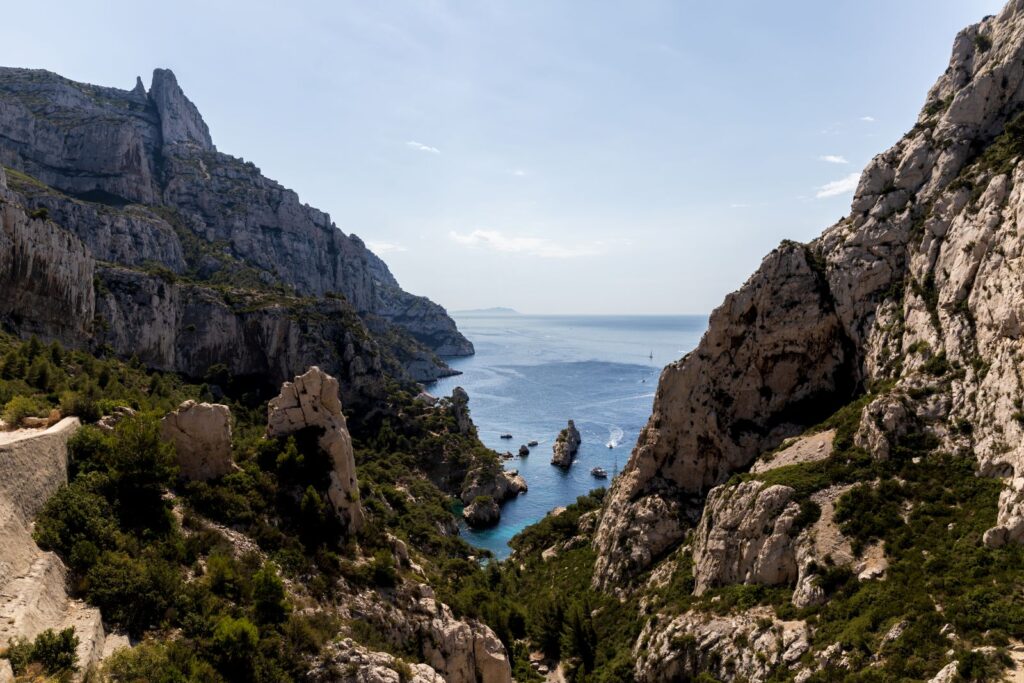
Marseille is especially famous for its Calanques National Park, a true haven of peace and nature covering 520 km2 (85 km2 of land core, 435 km2 of marine core). This massif with its purely Mediterranean essence is one of those little corners of paradise along the coastline of the South of France.
Countless trails run through the Calanques massif from Les Goudes and Marseilleveyre, notably the GR 98-51 hike linking Marseille to Cassis. As the name suggests, it is home to many calanques:
- Sormiou and Morgiou: these are the “inhabited” coves. Here you'll find the famous Marseille cabanons, small cottages without running water or electricity (for the most part). Morgiou is also home to a small, active fishing port;
- Sugiton: highly popular for its famous “Torpilleur” rock, which looks like a submarine. Please note: In summer, access to Sugiton is limited and requires a free online reservation to protect the site from erosion.
- The calanque of En-Vau is often considered the most beautiful. Nestled between high white limestone cliffs, it offers strikingly turquoise waters. It is a paradise for climbers and kayakers.
Discover the calanques from the sea on a sailboat trip!
Pour voir vraiment les calanques, il faut les découvrir depuis la mer : c’est là qu’on accède aux plus beaux spots, loin de la foule ! Découvrez Sugiton et Morgiou et d’autres criques bien plus secrètes lors d’une journée calanque à bord de notre voilier Bruine Beer.
⛵ Book my sailboat trip in the calanques
7. The Frioul Islands and the Château d'If
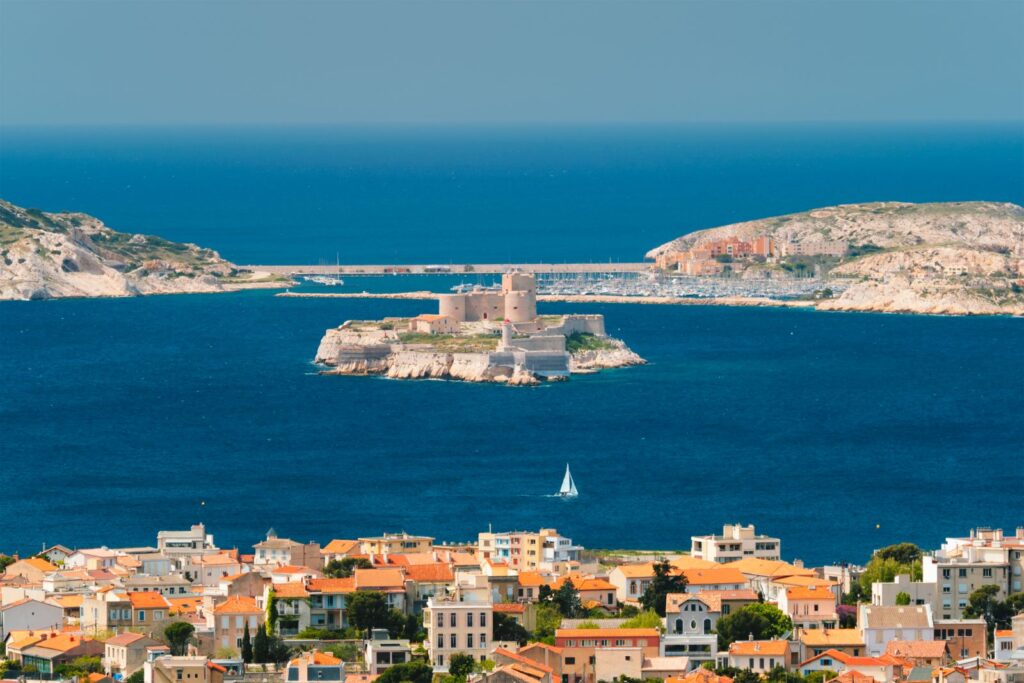
The Frioul archipelago is a cluster of islands facing Marseille. It is made up of four main islands: If, Pomègues, Ratonneau and Tiboulen. The Frioul islands are home to the Château d'If, world-famous thanks to Alexandre Dumas's novel. Built by François I in 1524 to protect the harbor, on the smallest islet of the archipelago, the Château d'If served as a prison for 400 years.
To the south, the island of Pomègues, the wildest. To the north, Ratonneau, livelier, home to the village, restaurants and the impressive Caroline Hospital, a former quarantine center for travelers suspected of carrying yellow fever. Each of the Frioul islands shelters coves with crystal-clear waters and rare flora.
On se rend sur les îles du Frioul en bateau : 20 min pour If du Vieux-Port, 30 min pour le Frioul.
Discover our sailboat sea trips around the Frioul islands! ⛵
Where to go for a stroll in Marseille? Parks and coastline
On foot or by bike, we've gathered here the best spots for walks and strolls in Marseille to discover the city.
8. The Corniche Kennedy
Besides the calanques, one of the most beautiful walks in Marseille is the one along the Corniche Kennedy. This walk hugs the coastline for about 5 km from the Catalans beach to the Prado beaches (or the other way around).
Allow 1 hour 15 minutes to do it in one go, and two hours if you like to linger. Because you will inevitably pass through some of Marseille's most picturesque and remarkable spots: Monuments aux Morts d'Orient, the small port of Vallon des Auffes (where stopping for a drink is a must). We recommend a detour through Malmousque, a small coastal path lined with huge limestone rocks. You are sure to see locals and visitors soaking up the sun. In summer, you can even swim there.
Farther along, the Corniche Kennedy reveals its continuous bench stretching over 3 km, listed in the Guinness Records. Along its sides you can spot mosaics created by local associations and schools.
Walking the Corniche Kennedy on foot, or by bike on the bike path from the Catalans to the Prado.
One car-free Sunday per month (entertainment, dancing, games, music) La voie est libre, to be checked on the City of Marseille website. It is possible to reach the Corniche Kennedy from Notre Dame de la Garde easily on foot (20-30 min) through the Roucas Blanc district.
9. The Palais du Pharo
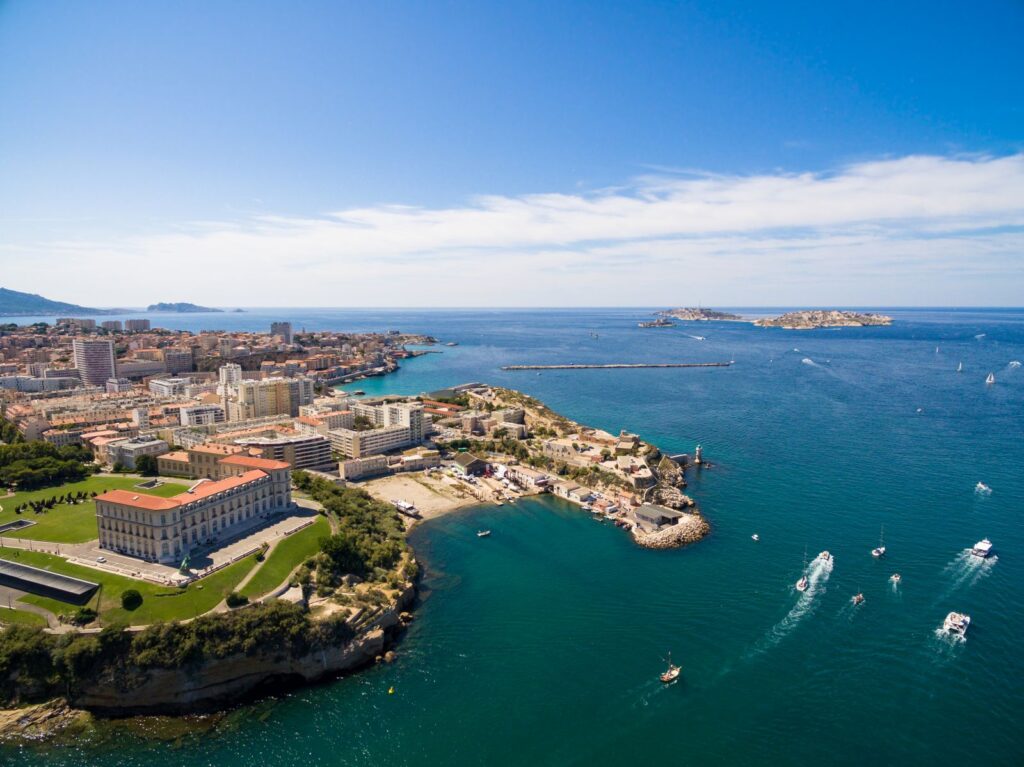
The Palais du Pharo is a 19th-century imperial residence overlooking the entrance to Marseille's Vieux-Port. It was built at the request of Napoleon III for Empress Eugénie. Completed in 1870, it never housed Emperor Louis Napoleon, by then held captive by the Prussians, an event that heralded the fall of the Second Empire.
Now a public park, the Palais du Pharo today serves as a convention center as well as a green space. Together with the Palais Longchamp, the Palais du Pharo is one of the most beautiful parks in the city of Marseille. Set on the waterfront, it offers a breathtaking view of the Mucem, Fort Saint-Jean, La Major Cathedral, the Vieux-Port, the city center, l'Estaque and the hills of Saint Barnabé.
Free and open from 7 am to 9 pm. May be closed due to wind.
Visit the interior of the Palais du Pharo during the Journées du Patrimoine (Heritage Days), the third weekend of September. You can walk from the Vieux-Port (20 minutes) or take bus line 83 (Pharo stop).
10. The Palais Longchamp
The Palais Longchamp est un sublime monument à voir sur Marseille ! Datant du XIXe siècle, c’est l’un des plus beaux ensembles architecturaux de la ville. Il a été construit sous Napoléon III pour célébrer l’arrivée de l’eau de la Durance, qui a sauvé Marseille du choléra et de la sécheresse.
The Palais Longchamp fountain stands 10 meters high! The water gushes down successive cascades into large basins. The allegorical female figure symbolizes the Durance, flanked by two other women representing the fertility of the land: wheat (the harvest) and vines (the grape harvest), on a chariot drawn by three Camargue bulls. The Palais Longchamp is a highly charismatic and impressive place, with a breathtaking view from the Palais terraces. Behind it stretches the park, perfect for a leisurely wander. There is also a waterfall at the bottom of the stairs, on the way to the metro exit. It is a place for strolling that is much loved, with two museums and a vast park behind the water tower.
From spring onwards, many events take place in Longchamp park. Around the park, Boulevard Longchamp and Boulevard Philippon are full of welcoming bars and gourmet restaurants.
Longchamp park is open from 7 am to 7 pm in winter, in summer (from June 1 to August 31) from 7 am to 9 pm. You can get there by tramway with line 2, Longchamp stop.
Musée des Beaux-Arts open Tuesday to Sunday from 9 am to 6 pm.
Muséum d'Histoire naturelle open Tuesday to Sunday from 9 am to 6 pm.
Réservez votre balade en bateau à bord de Bruine Beer
Au départ du Vieux-Port, votre excursion magique en bateau dans les calanques de Marseille
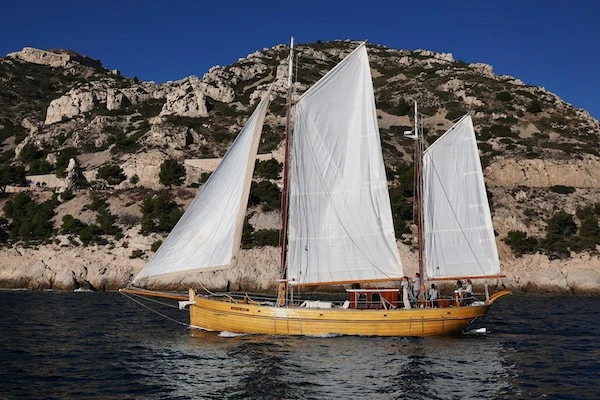
Journée en bateau dans les Calanques
Partez pour une journée de rêve à la découverte des calanques de Marseille.
Discover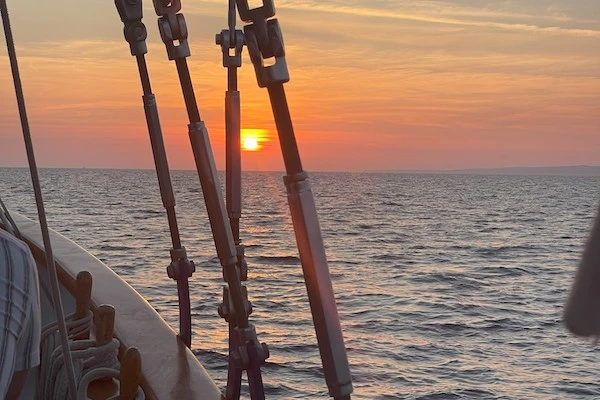
Evening boat trip in Marseille
Offrez-vous une soirée d’exception en mer, face à l’archipel du Frioul ! Apéritif et dîner à bord.
Discover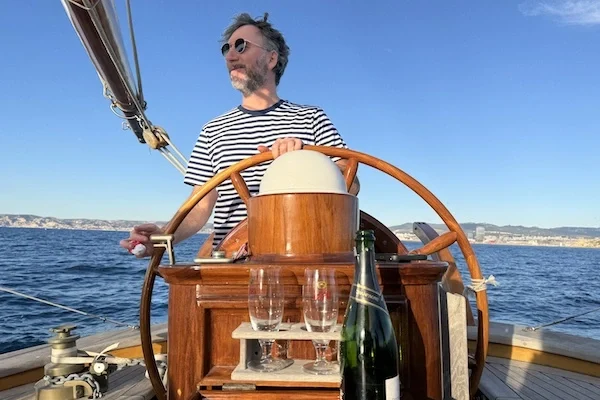
Ship privatization
Une expérience exclusive en privatisant Bruine Beer pour une croisière sur mesure.
Discover Français
 English
 Español